5201 Blue Lagoon Drive Waterford Business Park, Miami, FL 33126 Mon–Fri 8:00am – 5:00pm

Post Weld Heat Treatment

Controlled heating, soaking and cooling to relieve residual stress and keep your welds sound in service.

Post weld heat treatment
Service · Post Weld Heat Treatment

Relieving stress so welds last.

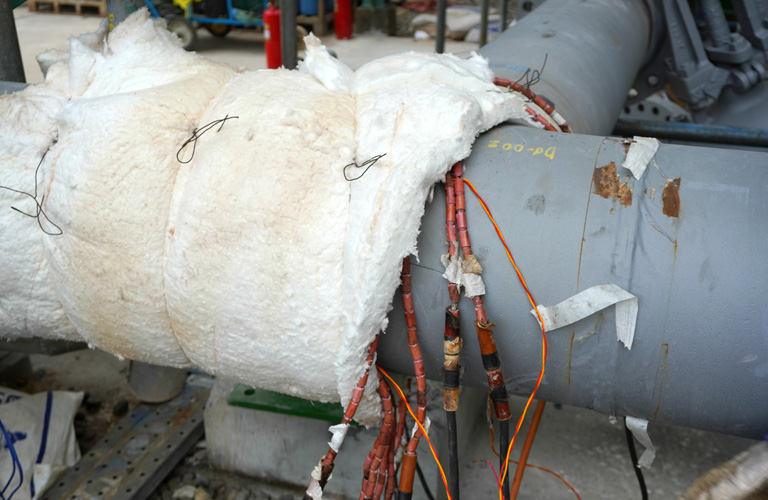
Post-weld heat treatment (PWHT) reduces or redistributes the residual stresses introduced by welding, using a controlled cycle of heating, soaking and cooling the weld and surrounding base metal. Done correctly, it restores ductility, lowers hardness in the heat-affected zone and helps prevent cracking in service.

We perform PWHT as a normal part of fabrication wherever the governing code or material requires it — closely tied to ASME piping and Section IX welding requirements — with calibrated equipment and documented temperature charts for every cycle.

Request a Quote
Why It Matters

What PWHT does for your piping

Relieves Residual Stress

Welding locks in stresses as the joint cools; PWHT relaxes them before they can cause distortion or cracking.

Restores Properties

Tempering softens hardened zones and recovers toughness and ductility in the heat-affected zone.

Prevents Cracking

Lower hardness and residual stress reduce the risk of stress-corrosion and hydrogen cracking in service.

Meets the Code

For many materials and thicknesses, PWHT is a code requirement — we perform and document it accordingly.

Methods

Controlled cycles, documented results.

The right heat-treatment cycle depends on the alloy, wall thickness and governing code. Common approaches we perform include:

  • Stress-relief / tempering — heating below the transformation range, soaking, then controlled cooling to relax residual stress
  • Normalizing — refining grain structure to restore uniform mechanical properties
  • Preheat & interpass control — managing temperature before and during welding to avoid cracking in higher-alloy steels

Soak temperatures and hold times are set to the applicable code — for example, ASME B31.1 power piping generally applies stricter, time-per-thickness holds than B31.3 process piping. Every cycle is recorded on a calibrated chart.

ServiceStress relief · tempering · normalizing
ControlPreheat, soak & interpass monitoring
DocumentationCalibrated time-temperature charts
Governing codesASME B31.1 · B31.3 · Section IX
IntegrationPerformed in-line with fabrication
FAQ

Heat treatment questions

No. The need depends on the material, wall thickness and code. Many P-No. 1 carbon-steel welds are exempt under ASME B31.3 when proper preheat and multipass welding are used, while thicker sections and alloy steels typically require it. We confirm requirements against your governing code.

Each PWHT cycle is recorded on a calibrated time-temperature chart showing heating rate, soak temperature, hold time and cooling rate. These records become part of your turnover documentation package.

Yes — localized heat treatment using resistance or induction methods can be applied to field welds, though we maximize shop heat treatment where possible for tighter control.

Code-Compliant

Heat treatment, handled in-house

We integrate PWHT into fabrication so your welds meet the code without adding vendors or delays.

Providing high-quality pipe fabrication and welding services to fit your project scope, schedule and budget — in the shop and in the field.

Get in Touch

5201 Blue Lagoon Drive Waterford Business Park, Miami, FL 33126 info@rhinecrest.com +1 (305) 218-8808